
Creativity Beyond Art
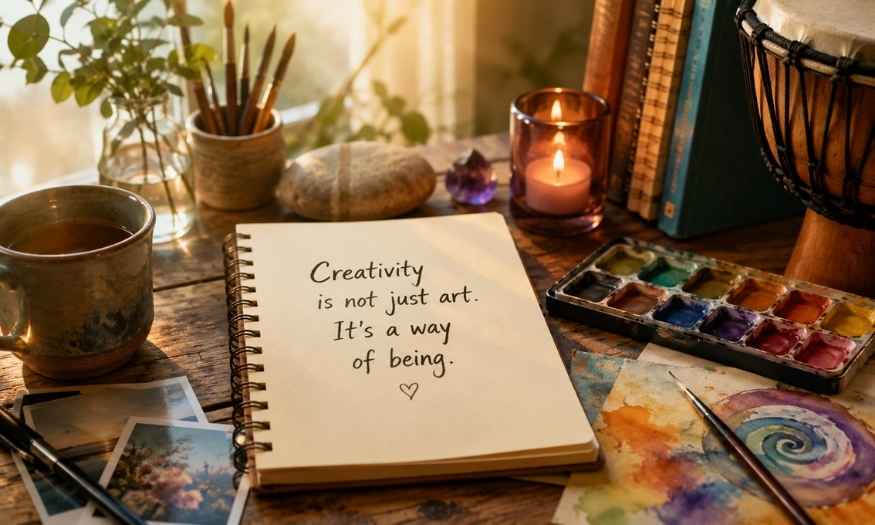
When people hear the word creativity, they often think of artists.
Painters.
Musicians.
Writers.
Designers.
People who create things that can be seen, heard or displayed.
For a long time, I thought creativity belonged mostly in those spaces too.
As a musician, creativity felt naturally connected to songwriting, performance and artistic expression. It was something I did when I sat down to write a song, develop an idea or create an experience for others.
Over time, however, I began to notice something.
Creativity was showing up everywhere.
Not just in music.
Not just in art.
But in everyday life.
The more I paid attention, the more I realised that creativity is not something reserved for a select group of people.
It is a human capacity.
One that lives within all of us.
Creativity Is Part of Being Human
Every day we are creating.
We create conversations.
We create relationships.
We create solutions.
We create routines.
We create opportunities.
We create meaning from our experiences.
Whether we realise it or not, we are constantly shaping the world around us through our choices, actions and perspectives.
Creativity is not simply the act of producing something artistic.
It is the ability to imagine possibilities and bring them into reality.
In that sense, creativity is woven into everyday life.
Creativity in Unexpected Places
Some of the most creative people I know would never describe themselves as creative.
They are parents finding new ways to support their children.
Teachers helping students engage with learning.
Business owners solving problems.
Community leaders bringing people together.
Friends finding ways to support one another during difficult times.
Creativity appears whenever we respond to life with imagination, adaptability and intention.
It is not limited to paintbrushes, instruments or stages.
Creativity often emerges in the way we navigate challenges, build relationships and contribute to our communities.
The Courage to Create
One of the biggest barriers to creativity is the belief that we are not creative enough.
Many people compare themselves to professional artists and conclude that creativity belongs to someone else.
But creativity is not about perfection.
It is not about producing masterpieces.
It is not about being the most talented person in the room.
Creativity begins with curiosity.
It begins when we ask:
"What if?"
"What else is possible?"
"What could I create here?"
Sometimes creativity looks like writing a song.
Sometimes it looks like trying a new approach to a problem.
Sometimes it looks like having a difficult conversation.
The common thread is not talent.
It is courage.
The willingness to explore something that does not yet exist.
Creativity and Self-Expression
For me, creativity has always been closely connected to expression.
Music became a way to communicate experiences, emotions and ideas that were difficult to put into words.
But expression can take many forms.
It can be found in the way we speak.
The way we move.
The way we decorate a space.
The way we share our ideas.
The way we show up in relationships.
Creativity allows us to bring something of ourselves into the world.
It transforms thoughts and possibilities into lived experience.
Creativity and Growth
One reason creativity matters so much is that it encourages growth.
When we create, we move beyond familiar patterns.
We experiment.
We learn.
We make mistakes.
We discover new possibilities.
Creativity reminds us that life is not fixed.
There is always another perspective.
Another solution.
Another way forward.
This flexibility can be incredibly valuable during times of uncertainty and change.
Rather than becoming trapped by what is, creativity helps us imagine what could be.
Reconnecting With Creativity
Many people feel disconnected from their creativity.
Often this happens because creativity becomes associated with performance, productivity or judgement.
We begin to believe that if what we create is not good enough, then there is no point creating at all.
But creativity does not require an audience.
It does not require recognition.
It does not require perfection.
Sometimes creativity simply means giving yourself permission to explore.
To play.
To experiment.
To follow curiosity without needing a particular outcome.
When we remove the pressure to perform, creativity often begins to return naturally.
Creativity as a Practice
Like rhythm, creativity is something we can cultivate.
Not by forcing inspiration, but by creating space for it.
Listening to music.
Writing.
Walking.
Daydreaming.
Having meaningful conversations.
Trying something new.
Spending time in nature.
All of these experiences can create conditions where creativity can emerge.
The goal is not to become more artistic.
The goal is to become more open.
More curious.
More willing to engage with life as a creative process.
Reflection Questions
As you reflect on your own relationship with creativity, consider:
- What does creativity mean to you?
- Where does creativity already show up in your life?
- Have you ever told yourself that you are not creative?
- What experiences help you feel inspired and curious?
- How might you create more space for creativity in your everyday life?
Perhaps creativity is not something we need to find.
Perhaps it has been there all along, waiting for our attention.
When we begin to see creativity beyond art, we start to recognise it as one of the ways we participate in shaping our lives, our relationships and the world around us.